

Specialist knowledge is no longer all it takes
Why the operating model is becoming a key success factor for agencies
The demands on communication are changing fundamentally, including in the healthcare sector. The factors driving this are not just new technologies and channels, but also a structural change in the overall way that marketing functions.
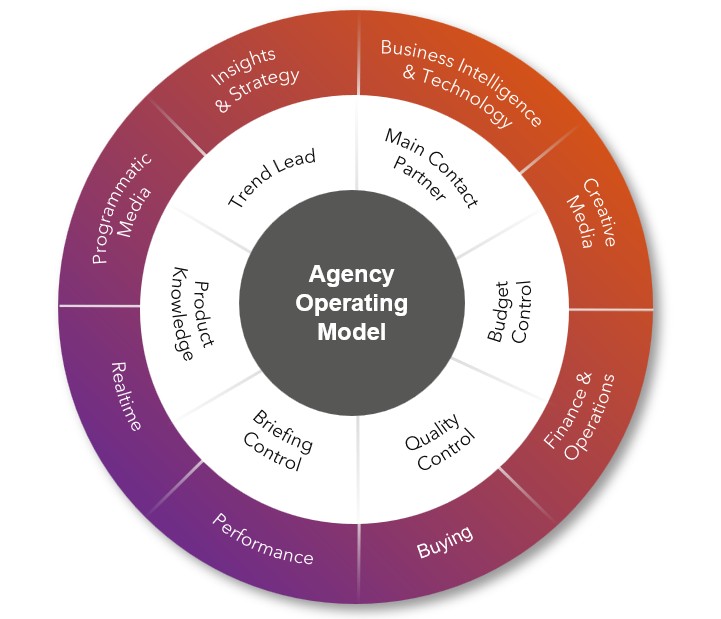
Agencies today face two simultaneous challenges: they need to expand their specialist subject matter knowledge further – and at the same time work in a manner more integrated than ever before. This development, which on its surface appears contradictory, gives rise to a very important question: how can different disciplines be connected in a way that produces a consistent, high-performing, integrated system? The answer: a new operating model.
From a range of services to a system architecture
International analyses describe this development as a shift towards integrated, data-driven and full-funnel agency models. In these models, creation, media, data, technology and experience no longer function separately but instead operate as an interconnected system.
In the past, communication services were frequently organised into clearly distinguishable disciplines such as PR, creation, media, digital and data. This structure is increasingly reaching its limits as campaigns these days are less about discipline-based logic. Instead, they apply:
• platform mechanics and algorithms
• Ai-driven decision-making processes
• complex target audience and journey structures
In addition, generative Ai and new discovery mechanisms are changing the way content is created and becomes visible. With that, the focus is shifting, too: what matters is no longer the individual range of services but rather the architecture that connects these services.
Market analyses show that clients increasingly are demanding more integrated models where creation, media, data and technology function as a cohesive system. What sets an agency apart is no longer the quantity of disciplines it offers. It is the quality with which those disciplines are integrated.
Ai is changing organisations, not just tools
Artificial intelligence (Ai), and in particular generative Ai and agentic Ai, is becoming a structural accelerator. Ai-assisted interfaces, search systems and response models are drastically increasing the consistency requirements, with content, data and messaging becoming visible and comparable across all contexts. Differences between strategy, content, media and actual user experience consequently become apparent more quickly. For businesses and agencies, that means:
• Inconsistencies are being exposed directly.
• Isolated actions are becoming less effective.
• Integrated and cohesive systems are becoming more important.
Ai therefore acts as a transparency and amplification mechanism, rewarding the cleanest system logic instead of the largest output. With it, communication is becoming less of a sequence of individual actions and more of an end-to-end, Ai-driven operating system.
Integration is a critical capability
Despite specialist knowledge growing and tools becoming more and more powerful, one problem still remains the same: integration. The relevant reports paint a clear picture: the biggest challenges are not a lack of talent or inadequate technology. The challenges are inefficient processes, fragmented systems and increasing complexity from isolated tools. Typical symptoms include separate data and content systems, a lack of integration of media and content strategies, rising complexity from tech stacks and limited transparency around RoI and impact.
In healthcare marketing in particular, this situation is intensified further by regulatory requirements, high evidence standards and heterogeneous audience mixes.
Integration is therefore becoming a central capability – and a key lever for efficiency, speed and effectiveness.
New expectations on agency partners
With this development, the requirements placed on communication partners are changing fundamentally.
Clients today no longer expect just services. Rather, they expect robust operating models which actually integrate creation, media, data, technology and processes transparently and at scale.
A model that is fit for the future involves three core components:
• specialist knowledge: subject matter depth, especially in regulated healthcare environments
• integration: seamless integration of disciplines, data and processes
• outcome focus: focus on measurable impact and not individual services
The demand is therefore shifting, and businesses are no longer looking for disciplines but rather functional, AI-assisted systems that deliver results.
Implications for healthcare marketing
For marketing managers in the healthcare sector, this development results in specific requirements:
• Communication must be consistent and cohesive across all channels.
• Earned and paid media can no longer be thought of separately.
• Data, content and distribution must be connected systematically.
• Visibility is increasingly coming from new, AI-based discovery mechanisms.
At the same time, the demand for evidence and impact is increasing, which makes the operating model a matter of strategic governance: how well are the systems, processes and partners aligned to achieving integration in practice?
Integrated systems determine the impact …
The development in the market is clear. Successful communication is no longer accomplished by adding together individual disciplines, but rather by integrating them into a well-functioning, integrated system. Accordingly, in the healthcare sector, specialist knowledge is becoming the basis, integration the key distinguishing factor and the operating model the crucial competitive edge.
At the same time, the criteria are changing: capabilities are increasingly being judged by how well communication is managed consistently, at scale and with evidence. Having a clearly defined, Ai-driven operating system – with transparent KPI logic, robust evidence backing the results and standardised workflows (e.g. generative Ai or agentic Ai throughout the entire communication and media life cycle) – is becoming the crucial indicator of maturity.
… and the choice of partner
For WEFRA LIFE, it is precisely this approach that boosts the Group’s capabilities. Its combination of consistent, specialised healthcare knowledge and integrated service architecture makes it possible to manage complex requirements systematically – from strategy development through to implementation across all relevant channels.
This ability to operate as an integrated system becomes particularly visible when integrated models are scaled – like in campaign structures that can be rolled out internationally or in journey-oriented approaches for platforms and awareness where content, audience logic and distribution are combined and orchestrated using Ai.
As such, WEFRA LIFE positions itself as a partner which not only provides individual disciplines, but also designs the underlying systems in such a way that communication is consistent, processes more efficient and results measurable.
Against this background, choosing the right operating model is in fact a significant, strategic decision, especially when the aim is to effectively combine specialist knowledge, integration and Ai-based visibility logic in healthcare marketing.

For improved readability, we do not use gender-specific language (male, female, diverse). All personal designations apply equally to all genders.
More posts

Artificial intelligence in healthcare marketing – vision or reality?

COMPRIX 2026: double gold for bold healthcare communications.