
Artificial intelligence in healthcare marketing – vision or reality?
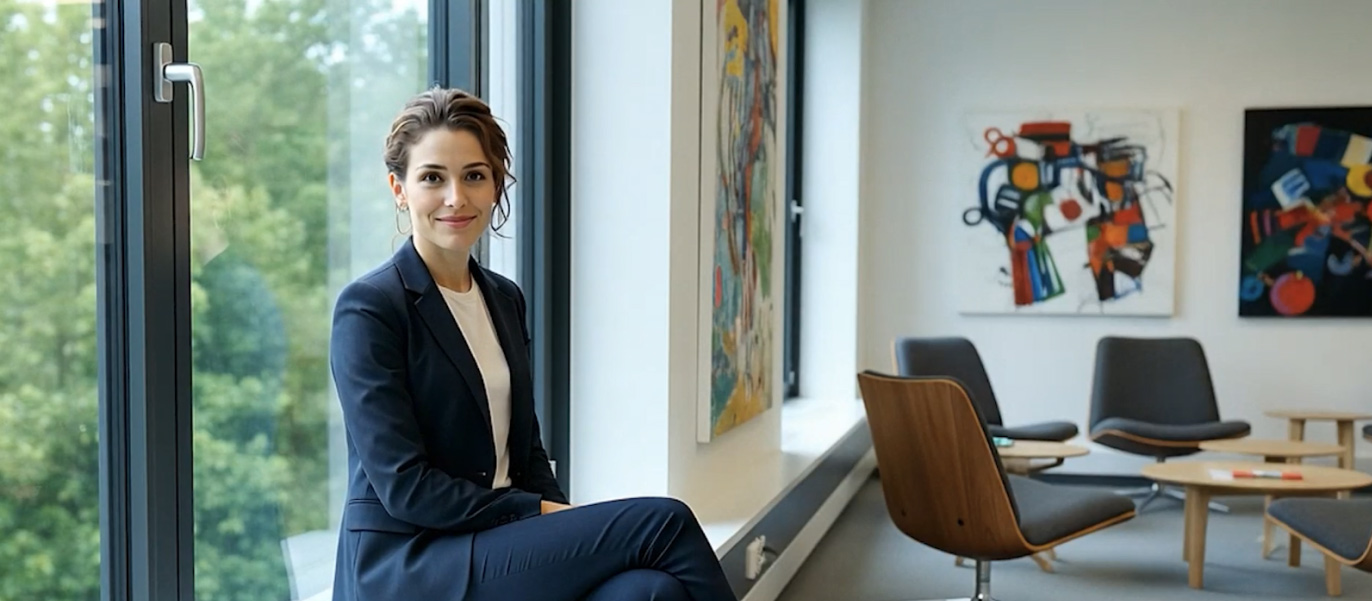
Generative AI is turning our working world upside down. There are new tools being developed every day, and for businesses the applications seem to be abundant. Detailing exactly what the potential of artificial intelligence is in healthcare marketing is what this new masterclass from WEFRA LIFE SOLUTIONS intends to do. However, this masterclass also differs from previous ones: the instructor is not an employee of the communications agency. The instructor is, in fact, a female avatar.
One year ago, it was impossible to think that an avatar would take the place of a human teaching the WEFRA LIFE SOLUTIONS masterclass. This makes it all the more clear that developments in AI are being made at breakneck speed. It is right now impossible to predict what tools will have revolutionised the market in just three months’ time. Yet what is it that drives this breathtaking progress? In short: the way that artificial intelligence learns. Its models learn using neural networks and by training on massive sets of data, all at enormous speed and across formats from text, images and videos to spoken language. It offers other revolutionary advantages, too. Generative AI possesses an immense, constantly growing repository of knowledge. It can perform interdisciplinary work, depending on the data basis, and delivers its results in seconds. And, these results can be modified just as quickly.

The female avatar hosting the WEFRA LIFE SOLUTIONS AI masterclass not only explains this astounding creative power to the viewer in words, but also shows it visually. How? By bringing the viewer along on a journey – a journey through worlds created digitally. Starting in offices, the background changes repeatedly with settings ranging from football stadiums to a recording studio, a treasure island, a court room, the roof of a high-rise building and even the inside of a human body.
Hollywood at the press of a button
At each of these stops, the avatar outlines the ways AI can be used for healthcare marketing. The benefits are sizeable above all for content creation as pharmaceutical campaigns, concepts and brand ecosystems can be generated linguistically, visually and acoustically in record time.
With AI tools, text production is taken to a new level. Custom text is created for the relevant audience in just seconds, whether it is for a blog post, package leaflet or even study abstract. Generative AI produces the same incredible output when it comes to images and videos, too, and at good quality. If desired, it delivers ‘Hollywood at the press of a button’. It is an ability that can be used in healthcare marketing for TV ads, explanatory videos or CMI training. The production times, personnel burden and costs are drastically less than they would be for ‘traditional’ development. Company apps and websites can also be coded quickly and affordably with the help of dev AI.
Other applications of generative AI span the entire marketing process, starting right from market and opinion research. For this, generative AI can simulate pre-tests and focus groups with good results. It can perform competition analyses with which businesses can quickly assess which products or campaigns will be received well. Artificial intelligence is similarly a helpful tool for community management and as a chatbot for customer service, for example, for answering FAQs or moderating comments.

Powerful, but not omniscient
While generative AI boasts a wide array of possibilities, its use still also comes with challenges and risks. It is not an infallible technology; for example, it can produce content that is not legally compliant or is objectively incorrect. This means that the professional expertise of a human will always be necessary for validating results for the foreseeable future. In this context, there will also be more regulations in future such as the EU AI Act to counter these problems. The same applies to data protection, too, for which agencies can help pharmaceutical companies to prevent improper use of AI and the risk of data breaches. Copyright law can also prove tricky, and it is important not to use protected data, images or terms in prompts and to be aware that purely AI-generated content is frequently not copyright protected.
Humans and AI: harnessing the potential
Given all of this, generative AI calls for a reconceptualisation of creative production processes. The design possibilities have increased while the production times, personnel burden and financial expense have shrunk rapidly. Be that as it may, the human factor remains indispensable. It is the human who gives the AI sensible instructions, refines its knowledge, adds to its creative output and validates its results. Most of all, humans and AI can achieve the best results when they work together. Here, the communications experts in Neu-Isenburg, Germany, have something to offer: being a partner to pharmaceutical companies, a partner which unlocks the optimal combination of human potential and AI – based on the state of the art in AI – to ensure cutting-edge, attention-grabbing and efficient healthcare marketing campaigns.
The team at WEFRA LIFE SOLUTIONS is available at masterclass@wefra.life any time for a deep dive or chat.
For reasons of better readability, the simultaneous use of the language forms male, female and diverse (m/f/d) is dispensed with. All personal names apply equally to all genders.
More posts

Specialist knowledge is no longer all it takes
Sustainability at WEFRA LIFE: